Introducing Then.Travel: Check the Area Before You Book
I have recently released Then.Travel, a travel-planning tool that helps people understand the area around a place they are considering booking.
When searching for accommodation, most travellers compare the property’s price, photographs, facilities, guest rating, cancellation policy and distance from major attractions. However, accommodation platforms often provide much less information about the wider neighbourhood.
A hotel or apartment may look ideal, but travellers may still want to know what the surrounding area is like before making a reservation.
This often leads to a separate research process. People search online for questions such as:
“Is this area of London safe?”
“Is this neighbourhood suitable for tourists?”
“Would I feel comfortable returning to this accommodation at night?”
The answers are frequently scattered across travel forums, old articles, social media discussions and personal opinions. Different sources may also provide contradictory information.
Then.Travel is designed to make this research process simpler.
Check a London Address or Area
The current version of Then.Travel focuses on London.
Users can search for a London address, postcode or supported location and receive an indicative safety score for the surrounding area.
The score is intended to provide additional context when evaluating accommodation. It is not a guarantee that an area is completely safe or unsafe, and it cannot predict whether an individual incident will occur.
Safety is complex and cannot be represented perfectly by a single number. A score should therefore be considered alongside other information, such as recent reviews, transport connections, the time of arrival and a traveller’s individual circumstances.
Then.Travel uses publicly available information to help produce its reports. Its documented data sources include street-level recorded crime data, the English Indices of Deprivation, Office for National Statistics geographic information, postcode data, OpenStreetMap and Transport for London data.
The purpose is to make this information easier to understand for travellers who may not have the time or specialist knowledge required to analyse several separate public datasets.
A report can provide information such as the area’s indicative score, recent crime trends, transport links and broader neighbourhood context.
Travellers can check more than one address when comparing different accommodation options. This may be useful when choosing between properties in different parts of London.
For example, one property may be more central but considerably more expensive. Another may be farther away but close to a convenient Underground or railway station. Safety and neighbourhood context can become one more consideration alongside price, location and guest reviews.
Safety Scores on Airbnb and Booking.com
After releasing the website, I extended the idea through a Google Chrome extension.
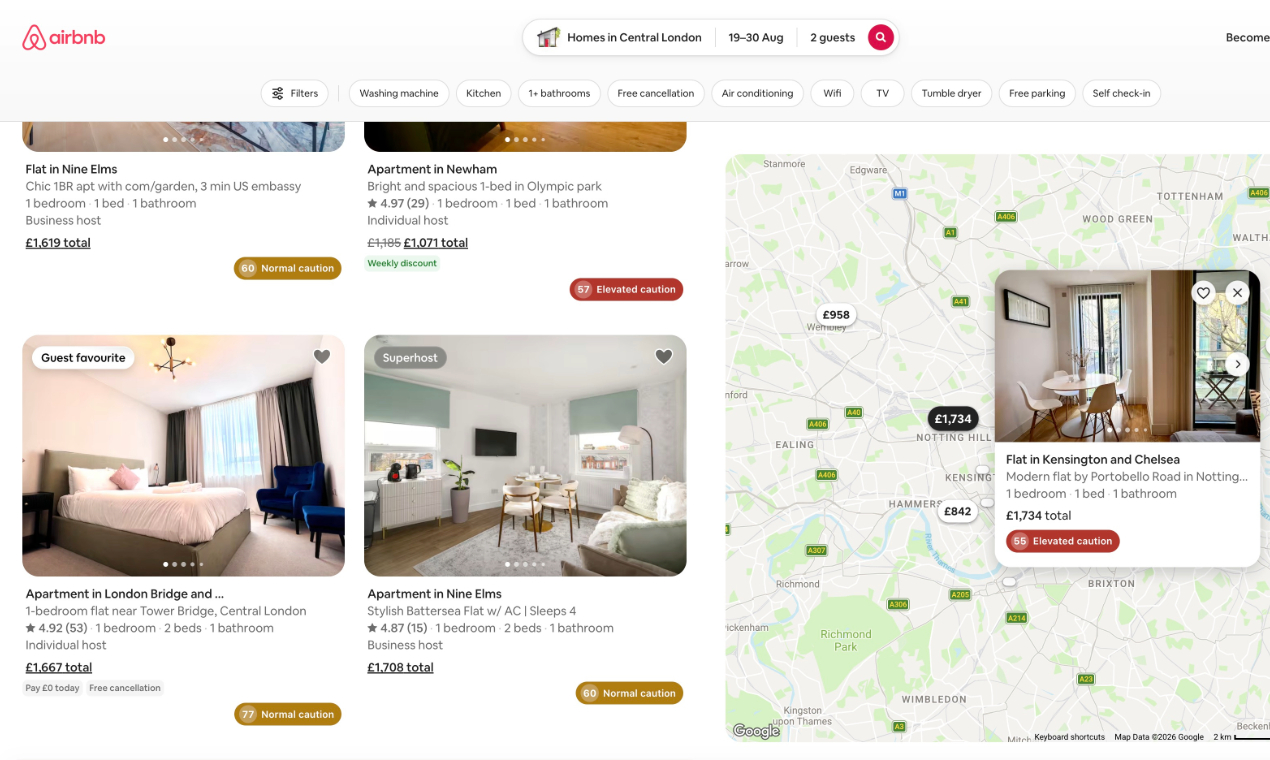
The extension enriches accommodation search results on Airbnb and Booking.com with an indicative safety score for supported London locations.
When browsing listings, users can see a score from 0 to 100 together with a general caution level. The score appears alongside the accommodation information already displayed on the booking platform.
Users can then click the score badge to open a more detailed Then.Travel report containing additional information about the area.
The extension does not replace Airbnb, Booking.com or their own review systems. It simply adds another layer of location information to the accommodation-search process.
This means travellers do not necessarily need to copy every address, open a separate browser tab and search for each location manually. They can see an initial indication while browsing the listings they are already considering.
The score is not currently a native Airbnb or Booking.com sorting option. It is an additional piece of information that travellers can take into account when deciding which properties deserve a closer look.
An Additional Tool for Travel Research
Then.Travel is not intended to tell people exactly where they should or should not stay.
Different travellers have different requirements and levels of comfort. A solo visitor arriving late in the evening may evaluate a location differently from a group travelling together. A family with young children may prioritise different factors from someone visiting London for a concert, conference or short business trip.
Official recorded-crime statistics also have limitations. Data can reflect reporting practices, population density and the number of people passing through an area. Busy central locations may record more incidents partly because they contain transport hubs, nightlife, shops and large numbers of visitors.