The homepage itself maintains a clean, minimalist design that prioritizes user action over clutter. At the very top sits the prominent “Rate My Professors” logo, immediately followed by the main search prompt: “Enter your school to get started.” This large, inviting input field encourages visitors to type the name of their institution right away, guiding them toward localized professor listings. Just below this is an alternative pathway labeled “I’d like to look up a professor by name,” which allows users to bypass the school selection step and search directly for a specific instructor regardless of institution. This dual-entry approach makes the site accessible for both new students exploring options at their campus and returning users who already know the professor they want to investigate. Once a school is selected, users are presented with searchable directories of faculty members. Each professor’s profile page serves as the heart of the platform. It displays an overall quality rating (calculated as an average on a 1–5 scale), a difficulty rating (also 1–5), and the total number of ratings received. A colorful “Would Take Again” percentage indicates what proportion of reviewers would enroll in another class with that instructor. Additional tags or attributes—such as “Gives good feedback,” “Respected,” “Inspirational,” “Lots of homework,” “Get ready to read,” or “Participation matters”—are frequently assigned based on recurring themes in student comments. The review section contains dozens or even hundreds of individual anonymous entries, each including a numeric breakdown, a written comment (often ranging from a single sentence to several paragraphs), the date posted, the course name (if provided), and sometimes the grade the reviewer received. These comments vary widely in tone: some are thoughtful and constructive, praising engaging lectures or helpful office hours, while others are blunt, humorous, or highly critical, focusing on perceived unfairness, disorganization, or personality clashes. A prominent section on the homepage encourages deeper engagement through registration. Titled “Join the RMP Family” with the playful tagline “Love RMP? Let’s make it official,” it highlights several benefits of creating an account. These include the ability to manage and edit previous ratings, the assurance that all contributions remain anonymous (even to professors), and the option to like or dislike other users’ reviews, which helps surface the most helpful or popular feedback. By registering, students can build a personal history of ratings, receive notifications about new reviews for favorite instructors, and contribute more actively to the community-driven database. The platform’s influence extends far beyond casual browsing. Many students report consulting RateMyProfessors.org as a key decision-making tool when building their class schedules, often treating high ratings as a strong endorsement and low scores as red flags. Critics, however, argue that the system can be biased toward entertaining or lenient professors rather than those who enforce rigorous academic standards. Reviews are anonymous and unverified, so a single disgruntled student can disproportionately affect an instructor’s score, while positive feedback from satisfied students may accumulate more slowly. Despite these limitations, the sheer volume of data provides a broad snapshot of student sentiment that is difficult to obtain through official channels like end-of-semester evaluations. Over the years, RateMyProfessors has evolved in response to user feedback and cultural shifts. Features like the former “hotness” chili pepper indicator (which assigned a playful “hot” badge to attractive professors) were eventually removed to focus more on pedagogical qualities. The site also includes basic campus ratings in some cases, allowing students to comment on school-wide aspects such as administration, facilities, or student life. Mobile compatibility ensures that users can check ratings on the go, especially during add/drop periods when decisions must be made quickly. In summary, RateMyProfessors.org remains a cornerstone of modern student culture—a democratized space where peer opinions shape academic choices. While it is not a perfect system and should be approached with critical thinking, its enduring popularity underscores students’ desire for real, unfiltered information about the people who guide their education. Whether used cautiously as one data point among many or relied upon heavily, the platform continues to play a significant role in how millions navigate higher education every semester.

Rate My Professor
RateMyProfessors is a popular online platform where students can anonymously rate and review their college professors and instructors.
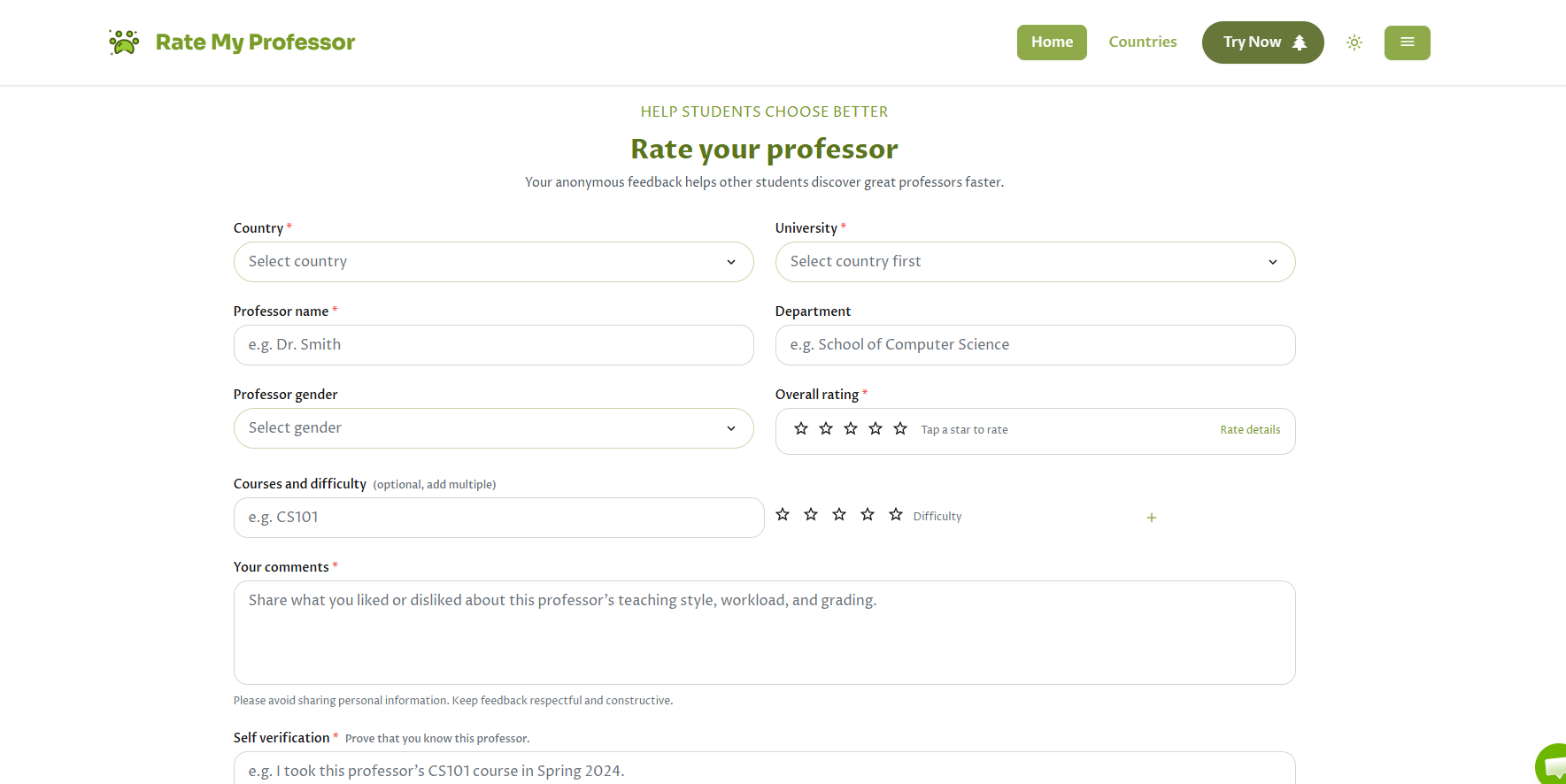
Rate My Professor Introduction
Alternative tools








More about Rate My Professor
PricingFree
Platforms
Web
ListedFeb 19, 2026
Authority Badge
Showcase your credibility by adding our badge to your website.